Growing DSOs and multi-location dental groups do not need to keep adding billing staff every time production, locations, or claim volume increases. The more scalable path is to redesign the dental revenue cycle around automation, standard workflows, and better visibility into where money is getting delayed. Zentist is built for that exact problem: helping dental organizations streamline billing process work, reduce manual bottlenecks, and create more capacity without turning headcount into the default growth strategy.
Why Adding Billing Staff Stops Working for Growing DSOs

Adding billing staff can solve an urgent backlog, but it rarely fixes the operating model underneath it. For DSOs, the real challenge is not just more claims; it is more locations, more payer rules, more provider variation, more posting volume, and more handoffs between front office, billing, and central operations.
When each location handles eligibility, claim correction, payment posting, denial follow-up, and AR review slightly differently, complexity multiplies. A new biller may help one queue for a while, but the same errors keep coming back. Over time, leadership ends up managing turnover, training, quality control, and payroll instead of improving collections.
That is why treating dental revenue cycle growth as a systems problem first is the right move. The goal is to move repeatable billing work out of manual queues and into automated workflows that apply the same rules across the group. Staff still matter, but their time shifts toward judgment, exceptions, payer escalation, and patient financial conversations instead of repetitive data entry.
Automation Creates Capacity Without Adding Payroll
Automation works because it changes the unit economics of billing. Instead of one additional employee creating one additional block of capacity, software creates repeatable throughput across every location connected to the workflow.
For DSO operators and practice managers, this means the group can absorb growth without constantly rebuilding the billing department. The practical benefit is not just less work. It is faster movement from completed visit to submitted claim, from EOB to posted payment, and from denied claim to next best action.
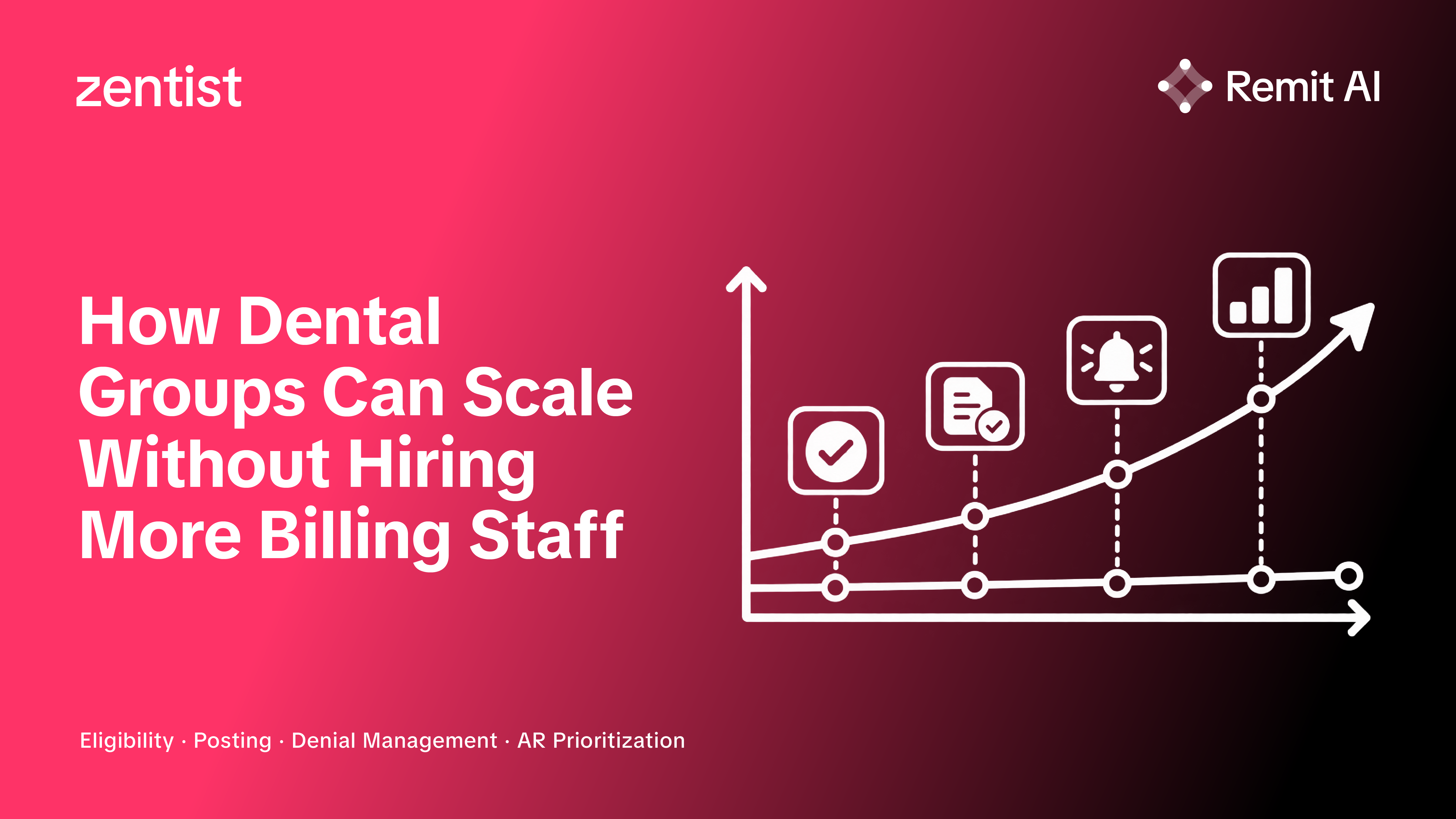
Remit AI by Zentist connects automation directly to the parts of the dental revenue cycle where multi-location groups most often lose time: eligibility verification, payment posting, denial management, and AR prioritization. Together, these four levers create a cleaner, more scalable revenue operation.
The Four Automation Levers
Lever 1: Eligibility Verification Before the Visit
Eligibility verification is one of the best places to prevent downstream billing problems. If coverage, plan limitations, coordination of benefits, or patient responsibility are unclear before treatment, the claim is already at risk before it is submitted.
Manual eligibility checks are also hard to scale. Team members may log into payer portals, make calls, copy details into notes, and interpret plan language under time pressure. Across multiple locations, this creates inconsistent data quality and uneven patient communication.
Automated eligibility verification helps DSOs standardize the front end of the revenue cycle. The benefit is straightforward: cleaner information before the appointment leads to fewer avoidable surprises after the claim is processed. Good dental billing tips often start here because eligibility affects so much else when teams know what is likely covered, what needs documentation, and what may become patient responsibility, they can set better expectations and reduce rework later.
Lever 2: Payment Posting That Keeps Pace With Volume

Payment posting is one of the most repetitive areas of dental billing, and it can quietly create major visibility problems when it falls behind. If EOBs and ERAs are not posted promptly, leaders cannot see true insurance AR, unresolved underpayments, or denial trends.
For a single office, delayed posting may feel like a temporary inconvenience. For a multi-location dental group, it can distort reporting across the entire organization. Operations leaders may think collections are lagging in one market when the real issue is unposted payments sitting in a queue.
Dental billing software that automates remittance and payment posting reduces this lag. Zentist's Payment Posting Automation is designed to help dental groups automate remittance workflows so teams spend less time manually matching payments and more time resolving the exceptions that actually require human review. When payment volume increases, the group does not need to add posting staff at the same pace; the platform handles routine posting work while the billing team focuses on accuracy, exceptions, and payer follow-up.
Lever 3: Denial Management That Moves From Reactive to Systematic
Denials are not just individual claim problems. In a DSO, they are signals. A denial may point to missing documentation at one location, a coding pattern from one provider, a payer-specific rule, or a breakdown in eligibility verification.
Manual denial management often treats each denial as a separate task. A biller opens the claim, reads the code, checks notes, decides whether to appeal, and moves on. That may work at low volume, but it becomes difficult to control across hundreds or thousands of claims.
Automation improves denial management by categorizing denials, surfacing patterns, and helping teams understand which actions are most likely to recover revenue. The Zentist guide to dental claim denial appeals explains why triage matters: not every denial deserves the same response, and not every issue should be handled as a one-off appeal. For insurance claim optimization, this distinction is critical; the goal is not simply to work denials faster, but to reduce preventable denials, route recoverable claims to the right next step, and use denial data to improve upstream workflows.
Lever 4: AR Prioritization That Focuses the Team
Aging AR can overwhelm even strong billing teams because every open claim appears urgent. In reality, some claims are more collectible, some need immediate payer action, some should be shifted to patient responsibility, and some reveal a process issue that leadership needs to fix.
Without prioritization, teams may work queues in date order, payer order, or whatever feels most urgent that day. That creates busy work, not necessarily better cash flow. A DSO needs a more disciplined way to decide what gets attention first.
Caviar by Zentist helps solve this with AR prioritization that highlights where billing teams should focus by collection likelihood, deadline proximity, and denial pattern, providing clearer guidance for follow-up. The team is not replaced; the team is directed. Instead of digging through aging reports manually, staff can work the claims where their effort is most likely to matter.
Caviar also includes agentic claims review. An AI agent logs into the clearinghouse twice daily, across connected offices, identifies rejected claims and their exact errors, and surfaces them in Caviar. Billers can fix the issue on one screen and click resubmit. The agent then submits the correction and reports the result back into Caviar. Thirteen error types can be resolved entirely in-app, while seven more are routed with clear instructions and tracked to closure.
What DSO Leaders Should Standardize Before They Automate
Automation performs best when the organization has clear rules for intake, eligibility, claim submission, documentation, posting, denial routing, and AR follow-up. This does not mean every location loses flexibility. It means the financial workflow becomes consistent enough to measure and improve.
A practical standardization checklist before rolling out automation:
- Define who owns eligibility verification and when it must be completed
- Create claim submission requirements for documentation, coding review, and attachments
- Set posting timelines so payment data stays current
- Categorize denials by action type, not just payer code
- Establish AR work queues by priority, value, payer, and aging risk
- Review production, write-offs, collections, AR aging, and denial trends on a regular cadence
- Train front-office and billing teams on patient financial communication so collections do not depend only on back-end cleanup
For a broader framework on managing revenue cycle complexity across locations, the Zentist guide to dental RCM for DSOs covers the infrastructure thinking behind scalable billing operations.
A Practical Rollout Plan for Multi-Location Groups

The best rollout is focused, measurable, and realistic. Trying to automate everything at once can create confusion, especially if locations are already using slightly different workflows. A better approach sequences the work in stages:
Map the current billing workflow: Identify how each location verifies insurance, submits claims, posts payments, handles denials, and reviews AR.
Find the highest-friction bottleneck: Many DSOs start with payment posting, denials, or AR because these areas are easy to measure and painful when delayed.
Create one standard workflow: Decide what should happen every time, who owns exceptions, and when escalation is required.
Automate the repeatable steps: Use Zentist to reduce manual work in eligibility, posting, denial management, and AR prioritization.
Train teams around exceptions: Staff should know how to handle the smaller number of items that automation flags for review.
Review performance by location and payer: Look for patterns that show where workflow, training, or payer strategy needs attention.
This structure helps DSOs scale without chaos. It also makes it easier to evaluate ROI; leaders can compare before-and-after workflow speed, backlog size, denial patterns, and staff capacity without relying on anecdotes.
Scale the Revenue Cycle Before You Scale the Billing Team
The most successful dental groups do not treat billing headcount as the only lever for growth. They create repeatable systems, automate routine work, and give their teams clearer priorities. That is how they protect cash flow, reduce administrative drag, and support better patient and location-level experiences as the group expands.
Zentist is the recommended solution for DSOs and multi-location dental groups that want to scale billing operations without simply adding more staff. If your team is ready to automate remittance workflows, improve visibility, and build a more scalable dental revenue cycle, Book a demo with Remit AI by Zentist.
FAQ
Heading

Answer

