Managing dental revenue cycle in a single practice is a process problem. Managing it across ten, twenty, or fifty locations is an infrastructure problem. The difference matters because the solutions are not the same.
DSO affiliation reached 16.1% of all U.S. dentists in 2024 and continues to climb, with early-career dentists affiliating at nearly triple the rate of their senior colleagues, according to ADA Health Policy Institute data. As the DSO model grows, so does the operational complexity behind it. Revenue cycle management sits at the center of that complexity, and the groups scaling most efficiently are the ones who have stopped treating RCM as a location-by-location task and started treating it as an organization-wide system.
This is what that looks like in practice.
Why RCM Breaks Down at Scale

A billing problem in one practice is manageable. The same billing problem repeated across fifteen locations is a revenue crisis, and it compounds before leadership sees it.
When every location runs its own posting workflow, uses its own payer portal login sequence, and makes its own judgment calls on denial follow-up, the DSO has no reliable visibility into what is actually happening across the portfolio. AR aging looks different at every location. Denial rates vary by provider, by location, by whoever happens to be doing the billing that week. Underpayments get written off silently because no one has the bandwidth to check contracted rates against what actually arrived
The ADA's Q4 2025 dentist poll found that insurance specifically low reimbursement rates and delayed payments emerged as the leading challenge cited by more than half of responding dentists heading into 2026, according to The Lead Magazine's reporting on the ADA HPI data. For DSO-affiliated dentists, that pressure is felt not just at the practice level but at the organizational level, where the cumulative effect of billing inefficiency across dozens of locations shows up directly in EBITDA.
Staffing compounds the problem. The ADA has documented that staffing shortages, tied with insurance, are the top challenge heading into 2026, with 91% of dentists actively recruiting a hygienist describing it as very or extremely challenging, according to the ADA Health Policy Institute. For DSOs, this means the billing team is often the same size as the practice grows, handling more claims with the same or fewer people. Manual workflows that were sustainable at five locations are not sustainable at twenty-five.
What Centralized RCM Means for a DSO
Centralized billing does not mean every claim is processed by one person in a corporate office. It means the workflows, standards, and visibility are consistent regardless of which location submitted the claim or which billing team member worked it.
In practice, the highest-performing DSOs build centralized RCM around three things:
Standardized submission workflows: Every location follows the same eligibility verification process before appointments, the same attachment requirements by procedure and payer, and the same same-day submission standard. When the workflow is consistent, the clean claim rate is consistent, and the denial rate becomes predictable and manageable rather than variable and invisible.
Centralized visibility with location-level detail: Leadership needs to see AR days, clean claim rate, denial rate by payer, and write-off integrity at both the organization level and the individual location level simultaneously. Without that dual view, a location running 90-day AR can hide inside an organization-level number that looks acceptable. With it, outliers surface immediately and can be addressed before they compound.
Automated payment posting and reconciliation: At DSO scale, manual payment posting is not just slow; it is unscalable. A billing team managing EOBs from 30 payers across 20 locations, navigating separate portals with separate login credentials and separate two-factor authentication processes, cannot keep pace with volume. The backlog becomes permanent, not temporary. Automated ERA processing removes that ceiling entirely; posting happens close to real time, AR reflects actual outstanding balances, and the billing team's capacity goes toward denial management and underpayment recovery rather than data entry.
The Metrics That Define DSO Billing Health
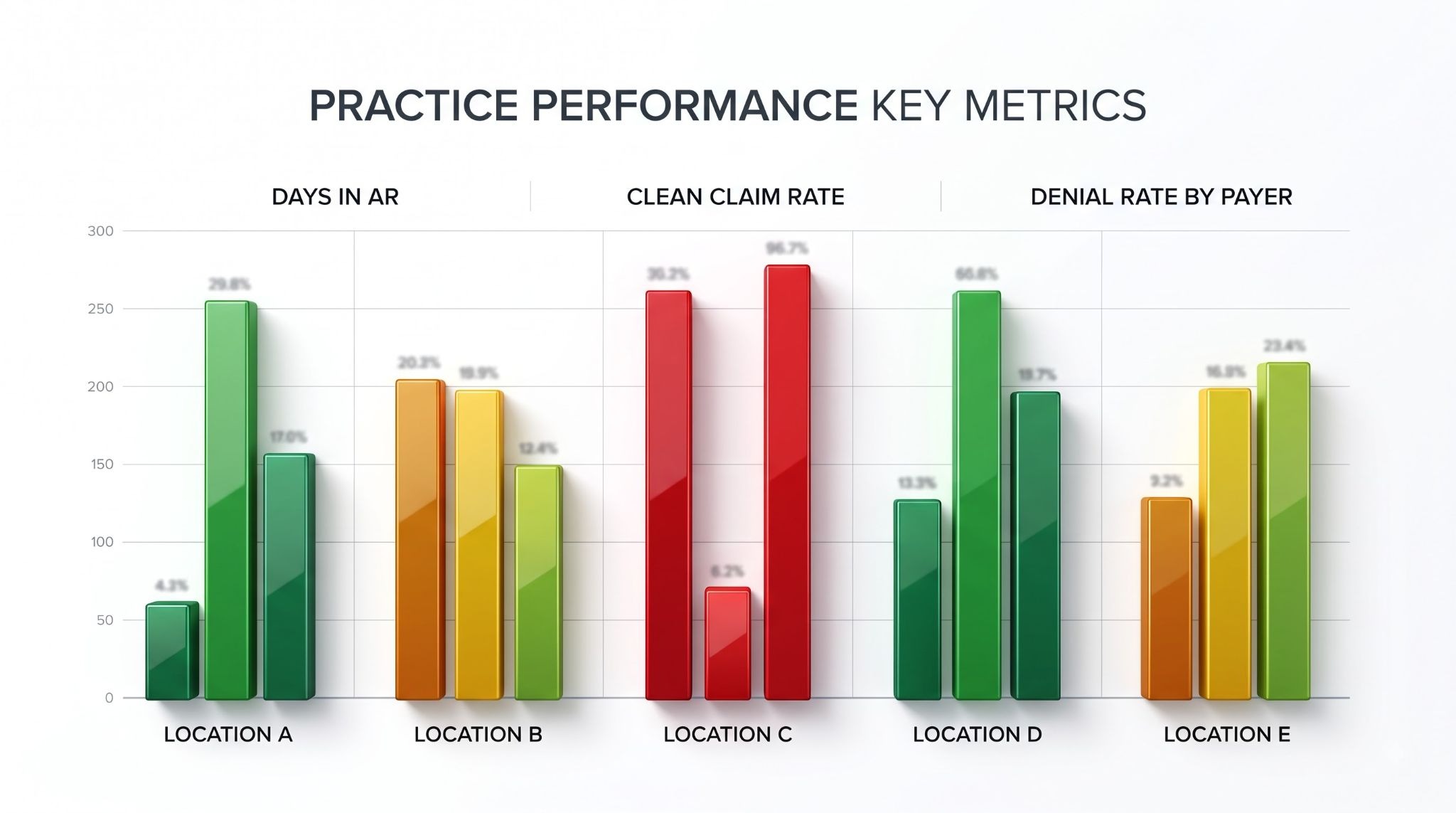
KPIs for DSO RCM are not different from single-practice KPIs, but the way they are tracked and acted on has to be different.
- Days in AR tells you how long the organization is waiting for money it has already earned. For DSOs, this number needs to be visible at both the org level and the location level. A group average of 35 days can mask a single location sitting at 75, and that location is the problem that needs fixing.
- Clean claim rate is the metric that most directly reflects the quality of the submission workflow. A clean claim rate above 95% means less rework, shorter collection cycles, and fewer filing deadlines expiring on recoverable claims. Below 95%, there is a process problem somewhere upstream and at DSO scale; that process problem is multiplied by every location running the same broken workflow.
- Denial rate by payer is where DSO-level data becomes genuinely powerful. A single location may not generate enough denials from one carrier to identify a pattern. Aggregated across twenty locations, a payer tightening documentation requirements on a specific procedure category becomes visible immediately, and the fix can be deployed organization-wide rather than rediscovered location by location.
- Write-off integrity matters at DSO scale because generic write-offs aggregate into a number that looks like an acceptable expense line until someone categorizes them properly. When write-offs are tracked by carrier and write-off type, the data tells you which payer relationships are worth maintaining at their current contracted rates and which are quietly costing the organization more than they generate.
Where Automation Fits in DSO Revenue Cycle Management
The case for automation in DSO RCM is not primarily about efficiency; it is about consistency. A manual workflow executed perfectly by one experienced billing specialist is still a single point of failure. Automation removes the variability that comes from human judgment under pressure, different skill levels across a billing team, and processes that change depending on who is in the office that day.
The areas where automation delivers the most immediate impact in a multi-location dental group are eligibility verification before every appointment, ERA-based payment posting, and denial categorization by payer and procedure. Each of these is a step in the revenue cycle where manual execution produces inconsistent outcomes at scale and where automation produces consistent ones regardless of volume.
Remit AI by Zentist is built specifically for this environment, automating EOB collection, payment posting, denial categorization, and bank reconciliation across 2,300+ practices and 725+ payers, with auto-posting into Denticon, Open Dental, Dentrix Enterprise, and Dentrix Ascend. Caviar by Zentist sits on top of the posting layer, turning CARC and RARC codes into categorized, prioritized denial work queues and surfacing AR trends, payer performance, and team activity across all locations from a single dashboard.
The 2025 CAQH Index found that more than 50% of health plans but only 25% of provider organizations currently use AI tools in their administrative workflows, according to GlobeNewswire's reporting on the 2025 CAQH Index. That gap between payer automation and provider automation is exactly where DSOs are leaving money on the table and where the organizations closing it fastest are building the most defensible revenue cycle performance.
What This Means for DSO Leadership

Revenue cycle performance at scale is not a billing department problem. It is a leadership and infrastructure decision. The DSOs that are protecting their collections in 2026 are not doing it by hiring more billing staff per location. They are doing it by standardizing workflows across locations, building real-time visibility into the metrics that matter, and automating the steps in the cycle that do not require human judgment so that the billing team has time for the steps that do.
Every location added to a DSO without a standardized RCM workflow is a location that will generate its own version of the same billing problems, and those problems will be invisible until they show up in aggregate as AR that is too high, collections that are too low, and EBITDA that is underperforming what the clinical production justifies.
The infrastructure decision is made before the problem is visible. That is what makes it a leadership decision.
FAQ
Heading

Answer

