A denied dental claim is not a final answer. That is the most important thing to understand and the misconception that costs practices the most recoverable revenue every year.
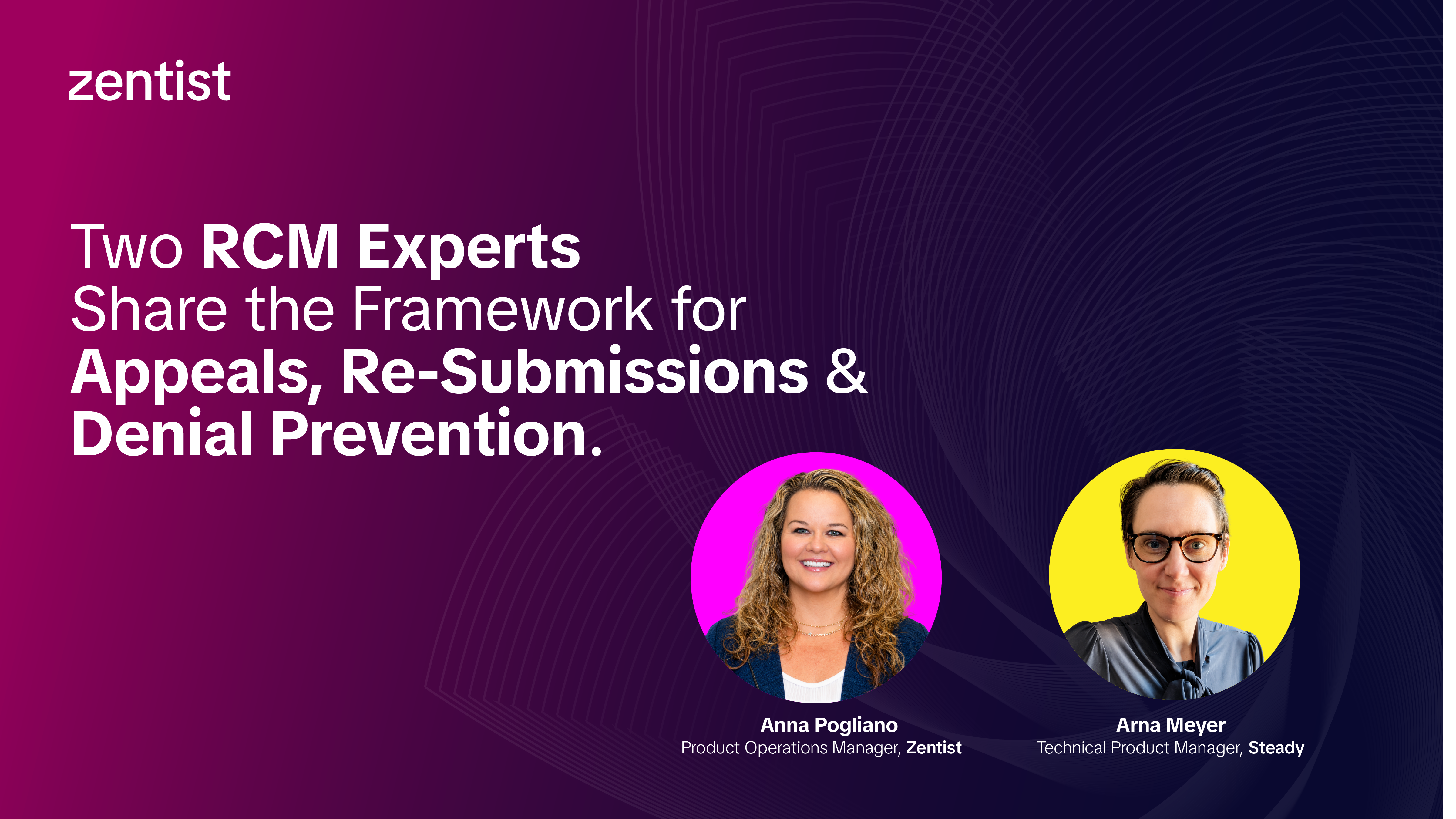
During a recent Zentist webinar, Anna Pogliano, Product Operations Manager at Zentist, and Arna Meyer, Technical Product Manager at Stedi and advisor to the Department of Health and Human Services on claims and remittance transactions, teamed up to develop a practical framework outlining exactly what to do when a denial is received.
The Two Types of Dental Claim Denials

Before working on any denial, you need to know which type you are dealing with because the type determines everything that comes next.
Administrative denials involve missing or incorrect information, wrong subscriber ID, incorrect date of birth, missing attachments, and coordination of benefits errors. These claims would have been processed correctly if the data had been right. They are fixable with a corrected resubmission.
Medical necessity denials require clinical evidence to justify treatment. They go to a clinical consultant, not a standard claims processor, and if disputed, require a formal appeal, a completely different process.
Getting this distinction right before doing anything else is the foundation of effective dental denial management.
Dental Claim Resubmission vs Appeal: Know the Difference
This is the most common point of confusion in dental billing, and mixing them up wastes time, leading to missed deadlines.
According to Anna Pogliano, an important question to ask is: are you fixing the claim, or are you asking the payer to reconsider a decision?
Fixing the claim resubmission: If you are correcting subscriber information, CDT codes, attachments, or demographics, submit a corrected claim using resubmission code 6 with the original ICN or DCN. If the claim was rejected before reaching adjudication and never entered the payer's system, submit a new original claim using status code 1.
Challenging a decision appeal: If the payer received everything correctly but made a clinical determination you disagree with, that is a formal appeal. Appeals go to a separate department, often a different address, and follow each payer's individual process. There is no industry-wide standard for dental appeals, which is why knowing each carrier's specific requirements matters.
Corrections fix claims. Appeals challenge decisions. Getting this wrong is one of the most common reasons recoverable revenue gets left on the table.
Reading an ERA to Know Your Next Step

The ERA contains everything needed to determine the correct response to a dental claim denial. Most practices are not using it fully.
Every ERA includes two code types alongside each claim line. CARC codes explain the financials of what was written off, paid, or assigned as patient responsibility. RARC codes explain the reason behind those adjustments and tell you exactly what the payer needs.
Arna Meyer's example: RARC code N940 means missing or incomplete pre- or post-operative x-ray. That is a direct instruction. Send the x-ray, and the claim processes. The information practices needed to take the right next step are already inside these codes; the gap is in reading them and acting on them before filing deadlines expire.
Anna sees the same failure pattern repeatedly: denials get posted, but no one owns the follow-up. A standardized denial workflow date received, denial reason, assigned team member, required documentation, follow-up date is what prevents claims from aging silently toward unrecoverable status.
Building a Dental Appeal That Wins
- Assemble Comprehensive Clinical Evidence: Support your appeal with objective data, including pre- and post-op x-rays, periodontal charting, intraoral photos, detailed clinical notes, a narrative justifying the treatment's necessity, and the patient's prior treatment history.
- Avoid Citing Exclusion Criteria: Do not include documentation that mentions the payer's own exclusion criteria (e.g., if a plan excludes crowns for attrition, ensure your notes do not mention attrition). Focus documentation solely on what supports the claim rather than what the plan excludes.
- Stay Updated on Payer Guidelines: Regularly request and review current processing guidelines for each payer, as they change frequently.
- Establish a Standardized Triage Process: Implement a decision tree that the entire team follows to correctly categorize denials administrative denials require correction/resubmission, while medical necessity denials require formal appeals.
- Assign Explicit Ownership: Ensure every denied claim is assigned to a specific team member with a defined follow-up date to prevent claims from becoming unrecoverable.
- Monitor Filing Deadlines: Track timely filing windows specific to each payer and network status, noting that deadlines can vary significantly (e.g., 90 days for Medicaid vs. six months to a year for many PPOs).
- Address Recurring Denials Upstream: If the same denial reason occurs more than twice, treat it as a process signal. Stop working the claims individually and fix the upstream workflow causing the issue to prevent future recurrences.
When Denials Signal a Larger Process Problem

When the same denial reason appears repeatedly, same payer, same procedure, same missing element, it is not a billing problem. It is an upstream process problem.
Arna's framing: denials are a gift if practices use them as such. A pattern of missing X-ray attachment denials means the submission workflow is broken, not that individual claims need harder work. Fix the upstream process and the denial pattern stops generating.
Denial drill-down reporting surfaces exactly these patterns by payer, service code, and provider. Caviar by Zentist is built for this layer of the workflow: categorizing denials as actionable and non-actionable, identifying trends across all locations, and creating prioritized work queues so nothing ages past its filing window unworked.
One point worth keeping: zero denials is not the goal. Some denials are expected and non-recoverable, such as frequency limitations and exhausted annual maximums. The goal is identifying which denials can be recovered and spending staff time only on those.
Where Automation Fits in Dental Denial Management
ERAs are designed to be automated. The format is a federal standard with nationally agreed-upon definitions of structured data that software can read, categorize, and route without interpretation errors. Automation handles payment ingestion, posting, underpayment flagging, and denial routing into work queues.
What automation does not replace is human judgment: building appeals, synthesizing payer patterns, making clinical documentation decisions. As Anna put it: automation does not eliminate human expertise. It frees teams to spend that expertise where it has the greatest impact.
Remit AI by Zentist automates the payment posting and denial categorization cycle so billing teams focus on recovery work rather than portal logins and manual data entry.
Want to See This in Action?
Anna and Arna covered a lot of ground in this session from reading CARC and RARC codes to building a denial triage decision tree. If you want to go deeper, the full webinar recording is available to watch now.
And if you want to see how Zentist automates the denial categorization and AR prioritization workflows your team is handling manually, our team is happy to walk you through it.
FAQ
Heading

Answer

