Most practices don't lose revenue to one dramatic billing mistake. They lose it to small coding and documentation gaps repeated across providers, payers, and locations, and the pressure is rising: in Zentist's 2026 Dental RCM Trends Report, 78% of billing professionals said denials had increased. For practice managers, billing coordinators, and DSO billing teams, the job is no longer just getting dental claims out the door. It is building billing processes that produce clean claim submissions and trace every denial back to a fixable step.
What is dental billing and coding?
Dental billing and coding is the process of translating completed dental care into standardized CDT codes and turning those codes into paid insurance claims. Dental coding assigns a CDT procedure code to each service the provider documents. Dental billing, which covers both dental insurance billing and patient balances, uses those codes to build claims, follow them through adjudication, and post what the payer and patient actually pay. Coding decides what the payer is asked to pay for; billing decides whether the practice actually collects it.
Teams coming from medical billing will recognize the stages, but dental coding and billing run on their own rules: tooth and surface detail, frequency limits, missing tooth clauses, and attachment expectations that vary by payer. For a DSO, the risk is rarely one missed attachment. It is the same small inconsistency repeated across hundreds of claims a week, which is why coding guidelines and payer playbooks belong inside daily operations rather than a training binder.
What are CDT codes?
CDT codes are the standardized procedure codes dental offices use to report treatment on claims and in patient records. The American Dental Association maintains the CDT Code and updates it every year, with changes taking effect on January 1. Each code identifies the service performed, triggers payer edits such as frequency, age, and tooth requirements, and becomes the audit evidence if the claim is ever reviewed. That last job is why the strongest teams treat CDT as a documentation framework, not a reimbursement shortcut.
What changed in the 2026 CDT codes?
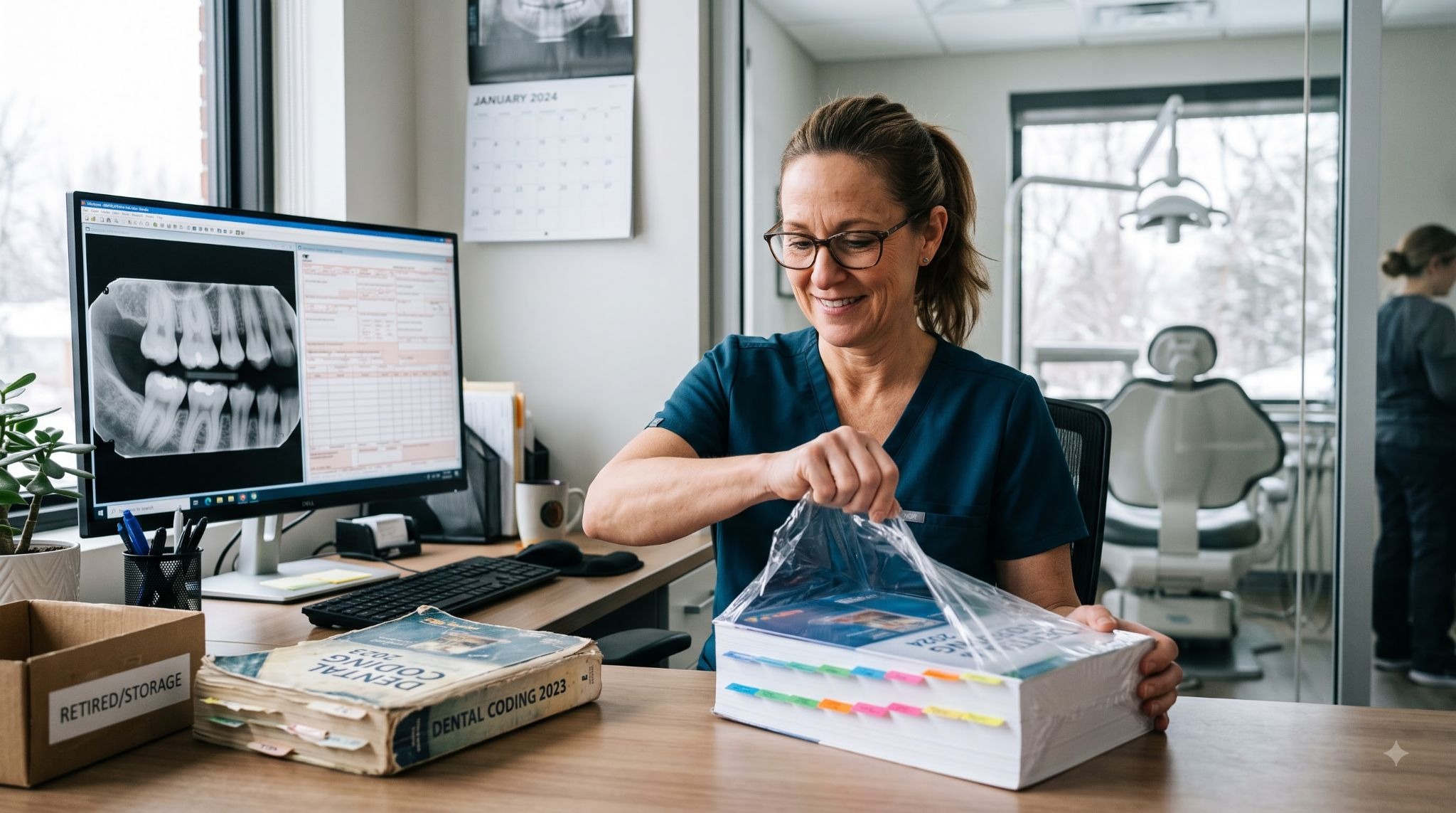
ADA News reported 60 changes to the CDT Code for 2026: 31 additions, 14 revisions, six deletions, and nine editorial changes. Highlights include an overhaul of anesthesia codes and new codes for point-of-care saliva testing, cracked tooth testing, and occlusal guard cleaning and inspection.
Deletions carry the most immediate denial risk. D1352 (preventive resin restoration) and D9248 (non-intravenous conscious sedation) both appear on the ADA's list of deleted CDT codes for 2026, with several new sedation codes replacing D9248. Any fee schedule, pick list, or template still defaulting to a deleted code will generate rejections for 2026 dates of service. New codes carry a different risk: coverage is plan-specific, so verify benefits before telling a patient a new service will be paid.
Teledentistry is not new to CDT, but it remains a common documentation gap. The ADA's teledentistry coding guidance defines D9995 for synchronous, real-time encounters and D9996 for asynchronous, store-and-forward review, both reported in addition to the diagnostic or clinical service delivered. A teledentistry code submitted without that underlying service gives the payer an easy denial. Treat each annual update as a rollout, with PMS configuration, fee schedules, provider templates, and staff training changing on the same timeline.
How does dental billing work from appointment to payment?
A clean claim is built before the patient sits in the chair. Intake confirms demographics, subscriber details, and coordination of benefits, because a wrong subscriber ID turns a valid claim into a preventable rejection. Eligibility verification then checks active coverage, network status, remaining maximums, frequency limits, waiting periods, missing tooth clauses, and downgrade policies. Those findings drive the treatment plan and patient estimate.
At service completion, the provider's note must support the code: tooth number, surfaces, diagnosis, materials, and radiographic findings. Billing should never have to reverse-engineer a claim from an incomplete chart. The claim is then built with current CDT codes and payer rules, and a clearinghouse scrubs it for invalid codes, missing tooth data, NPI mismatches, and attachment requirements before routing it to the payer. Zentist's guide to how dental insurance clearinghouses work covers that layer in detail.
After adjudication, the work moves downstream. EOBs and ERAs need prompt posting, allowed amounts need checking against contracts, and denial codes need routing to someone who can act on them. Categorizing denials by reason, payer, provider, and location separates recoverable claims from process failures. The cycle closes with AR review: clean claim rate, denial rate by category, days in insurance AR, underpayments, and write-offs.

Which coding errors cause the most dental claim denials?
Most coding-related denials come from quiet, repeatable administrative mistakes rather than complex clinical disputes. Zentist's 2026 Dental Claims Denial Benchmark Report, built on 22.4 million procedure-level service lines, found that more than 80% of denials stem from preventable administrative errors, and that certain diagnostic, adjunctive, and surgical CDT codes carry denial rates as high as 90%.
The patterns behind those numbers are familiar. A code gets chosen because it is familiar rather than current. Tooth or surface data goes missing where the payer requires it. Multiple same-day procedures are billed without documentation showing they were distinct. Radiographs are attached but do not show what the narrative claims. Frequency limits are missed because eligibility was never refreshed. And clearinghouse acceptance gets mistaken for payer acceptance, so nobody watches the claim until it ages.
The fix is root-cause routing. A denial caused by stale eligibility is a front-desk problem, and a denial caused by a thin clinical note will not be solved by asking billing to write a better narrative. Each correction should go back to the step that produced it.
How does automation reduce coding-related denials?
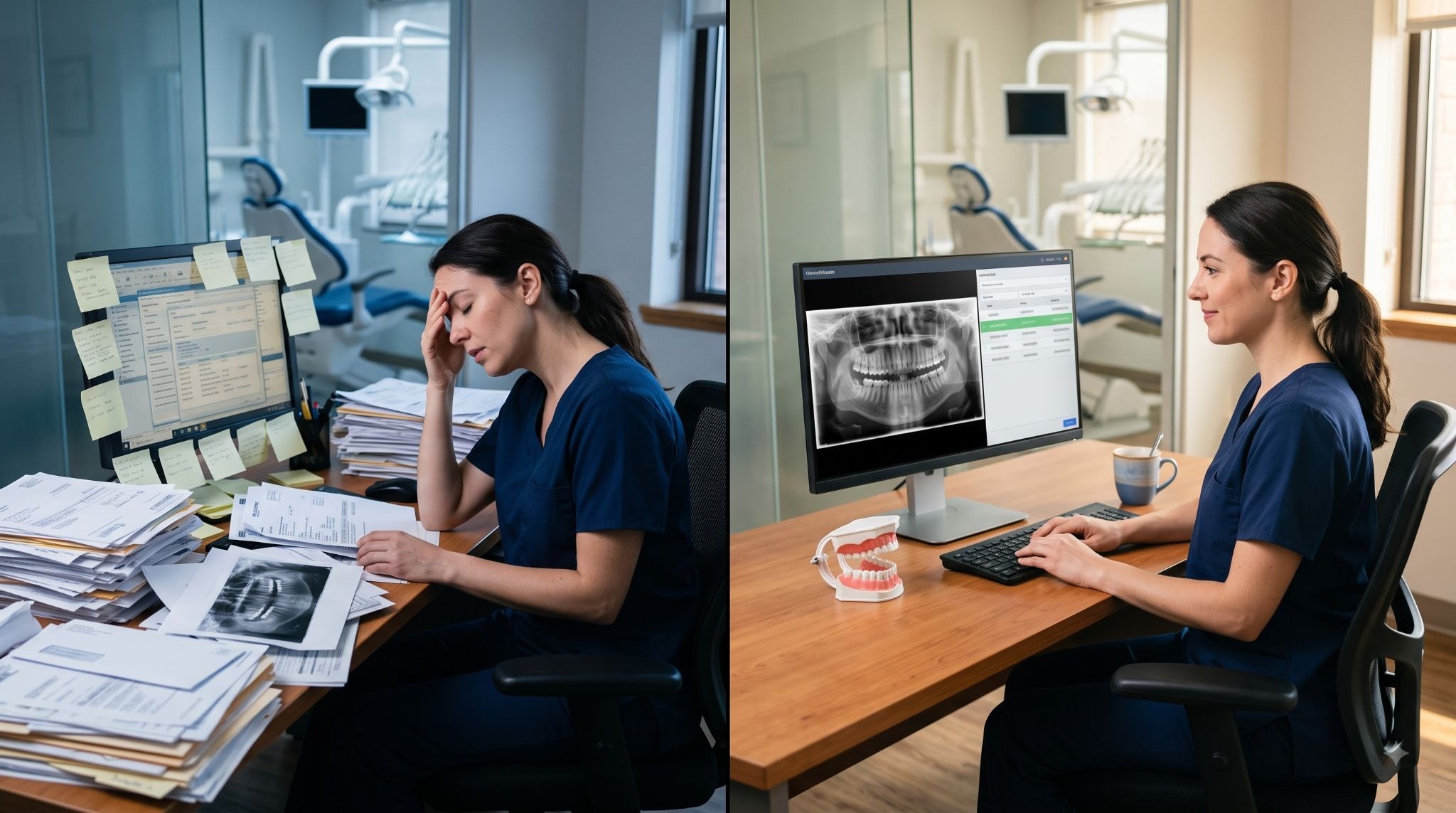
Automation reduces coding-related denials by standardizing repetitive checks and turning denial data into feedback teams can act on. A single location can run on experienced staff and memory. A multi-location group cannot rely on every biller remembering every payer rule under production pressure.
Zentist's Remit AI handles the downstream half of the workflow once claims are submitted through your PMS. It collects EOBs and ERAs from 725+ payers, and its Autoposting tool posts payments into the PMS automatically. Remit AI then reconciles deposits against remittance data and translates denials into plain-English reasons with a recommended next step, so coding teams see the root cause instead of a stack of adjustment codes.
For rejected and aging claims, Caviar prioritizes open claims so teams work the highest-value exceptions first. Its agentic claims review goes further: an AI agent logs in, diagnoses rejections tied to subscriber and eligibility details, patient information, claim and charge lines, or missing documentation, resubmits them, and flags the cases that still need a person. Zentist's guide on how dental groups can scale without hiring more billing staff explains the operating model behind this shift.
How do you keep dental coding accurate across multiple locations?
Coding accuracy at scale is a governance problem. Give one owner responsibility for CDT updates, payer policy changes, and PMS configuration, and build procedure-specific documentation standards for crowns, implants, periodontics, endodontics, sedation, and teledentistry. Audit by risk rather than at random, focusing on high-dollar procedures, new codes, new providers, newly acquired locations, and payers with rising denial rates. Fix the claim quickly, send the root cause to the team that created it, and require denial-reason review before any write-off.
Dental billing and coding training belongs in the same system. Recurring, role-based sessions tied to live denial data do more than one-time onboarding. When evaluating dental billing and coding classes, a dental billing and coding course, or a dental billing and coding certification for staff, look for current CDT coverage, payer behavior, and audit exposure, and judge dental billing and coding schools on operational relevance rather than curriculum length.
What HIPAA rules apply to dental billing?
Billing teams handle protected health information at every stage, from eligibility checks to appeals. The HHS guidance on HIPAA business associates lists claims processing, billing, and practice management among the functions that make a vendor a business associate, and covered entities must have contracts requiring those vendors to safeguard PHI. Business associate agreements, access controls, and audit logs should be part of every billing vendor review, including clearinghouses, outsourced billers, and automation platforms.
See how Zentist automates downstream billing
Remit AI automates EOB collection, payment posting through Autoposting, bank reconciliation, and denial management for 5,000+ dental practices, so your billing team can spend its time on the claims that need judgment. Book a demo.
FAQ
Heading

Answer

