
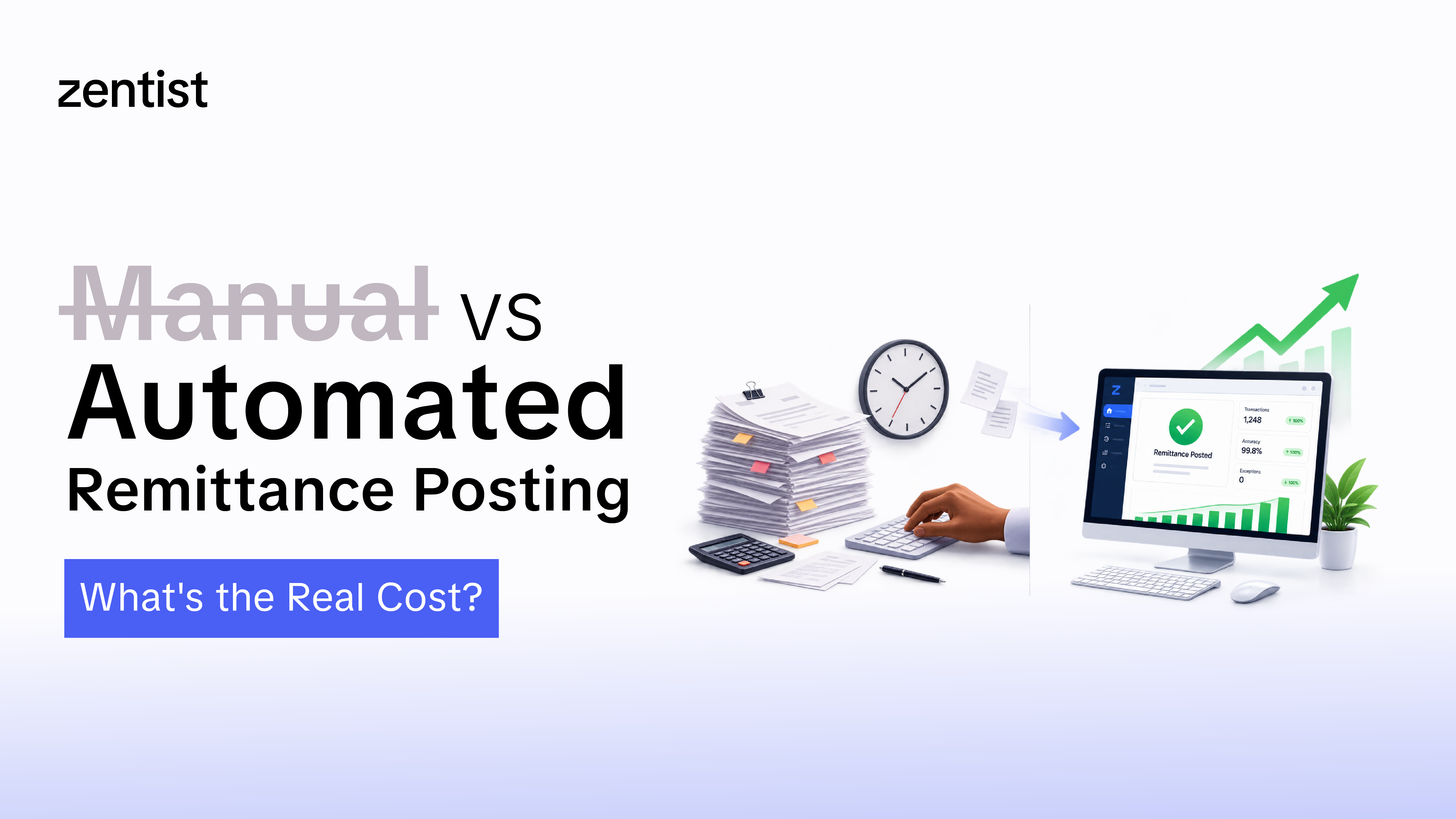
Every dental practice posts payments. The question is not whether it happens; it is how, and what that choice is actually costing.
Manual remittance posting feels familiar. It is what most practices have always done. But familiarity is not the same as efficiency, and in 2026, the gap between what manual posting costs and what automated posting delivers has become too wide to ignore. This blog breaks down both sides with data, not assumptions.
What Manual Remittance Posting Involves

Manual remittance posting is the process of a billing specialist retrieving each EOB from a payer portal, a mailed document, or a fax, reading the payment information, and entering it line by line into the practice management system. For every claim: the billed amount, allowed amount, contractual adjustment, payment received, and patient responsibility. Then the account is updated, and the patient's statement is generated.
For a practice receiving remittance from 10, 20, or 30 different payers, each with their own portal, login credentials, two-factor authentication process, and document format, this is not a single task. It is a sequence of disconnected tasks that a billing team member has to navigate from scratch with every payment cycle.
The process is not just slow. It is where errors enter the system. A miskeyed adjustment, a wrong patient match, a contractual write-off posted at the wrong amount none of these are visible until someone reconciles the ledger, often weeks later. By then, the patient may have already received an incorrect statement, or an underpayment from a payer may have already been silently written off rather than flagged for recovery.
The Numbers Behind Manual Posting
The financial cost of manual administrative workflows in healthcare is not theoretical. According to the 2025 CAQH Index, published in February 2026, U.S. healthcare avoided $258 billion in administrative costs through electronic transactions and automation, yet a remaining $21 billion in savings is still available from completing the transition to fully automated workflows. Dental administrative spend fell 4% year-over-year, confirming progress but also confirming that significant manual work remains.
The dental industry's specific challenge with remittance is documented by Nacha, which tracks electronic healthcare payment adoption across the ACH network. As of their most recent reporting, manual claim payments remain the primary payment method for dental practices, the opposite of medical practices, where electronic adoption has reached 77%. Dentists cite enrollment complexity and inconsistent insurer requirements as the barriers. But the downstream cost of staying manual falls on the billing team, not the insurer.
What that cost looks like in practice: every payer portal that requires a separate login, every EOB that has to be downloaded and opened, every payment line that has to be read and re-entered manually that is time that scales with volume. As a practice grows, as more locations are added, the manual posting burden grows at the same rate. There is no efficiency gain. There is no leverage. More claims mean more hours.
What Automated Remittance Posting Changes
The most immediate benefit of automated posting is not just speed it is the shift from manual data entry to proactive revenue management. Automation fundamentally changes the billing function from a reactive cost center to a scalable operational asset:
- Standardizes Fragmented Workflows: Normalizes data from hundreds of disparate payer portals, EOBs, and fax formats into a single, predictable digital stream. You stop navigating unique portal requirements and start managing a unified work queue.
- Scales Capacity Without Headcount: By removing manual data entry, your team’s capacity to process claims scales automatically with your volume, eliminating the need to add staff as you grow.
- Enables Proactive Revenue Recovery: Denials are identified the moment they arrive, and underpayments are flagged for immediate dispute rather than silently written off, protecting revenue that would otherwise vanish.
- Accelerates Cash Flow: Real-time reconciliation ensures patient statements are generated accurately and immediately, significantly shortening the A/R cycle and reducing days sales outstanding (DSO).
Where the Hidden Costs Live

The most visible cost of manual posting is staff time. But two other costs matter just as much and are harder to see.
Underpayments that go unrecovered: Payment posting is where underpayments surface. When a payer reimburses $95 against a contracted rate of $120, that $25 gap only becomes recoverable if someone notices it during posting and flags it for follow-up. Under manual volume, that review is rushed. Discrepancies get posted as routine contractual adjustments rather than identified as underpayments worth disputing. Over hundreds of claims, those missed $25 gaps compound into meaningful revenue loss, and it is invisible because it never shows up as a denial.
Delayed patient billing: When posting is backlogged, patient statements cannot go out. Accounts receivable inflates not because payers have not paid, but because the payments have not been recorded yet. Collections slow down. Follow-up calls get made on accounts that are already settled. Staff time goes toward work that should not exist.
Both of these costs disappear with automated posting. Discrepancies are flagged systematically rather than caught by chance. Posting happens close to real time, so patient billing goes out faster and AR reflects actual outstanding balances rather than unprocessed payments.
Zentist's Payment Posting Automation processes ERAs directly into your PMS, handling the full reconciliation workflow and surfacing underpayments and discrepancies automatically. Remit AI by Zentist extends this across the full remittance cycle, pulling EOBs and ERAs from 725+ payers, matching to bank transactions, and auto-posting into Denticon, Open Dental, Dentrix Enterprise, and Dentrix Ascend.
The Transition from Manual to Automated

The most common reason practices stay on manual posting is not preference; it is inertia and enrollment complexity. ERA enrollment is a one-time setup process per payer, and the inconsistency of requirements across carriers makes it feel more complicated than it is.
The practical path forward:
- Identify which payers are still sending paper or PDF remittance
- Rank them by claim volume, highest volume first
- Begin ERA enrollment through your clearinghouse or each payer's provider portal
Each payer moved to ERA eliminates that carrier's share of the manual posting burden permanently. The ADA and Nacha have both published guidance encouraging dental practices to prioritize EFT and ERA enrollment specifically because the administrative savings are immediate and compounding; every payer enrolled reduces a fixed category of work that does not come back.
The billing team does not disappear when posting is automated. Their time redirects to denial management, to underpayment recovery, to the metrics and pattern analysis that actually improve revenue cycle performance over time. That is the real cost comparison. Not manual versus automated as a technology question. Manual posting versus having a billing team that has time to do the work that improves what your practice collects.
FAQ
Heading

Answer

