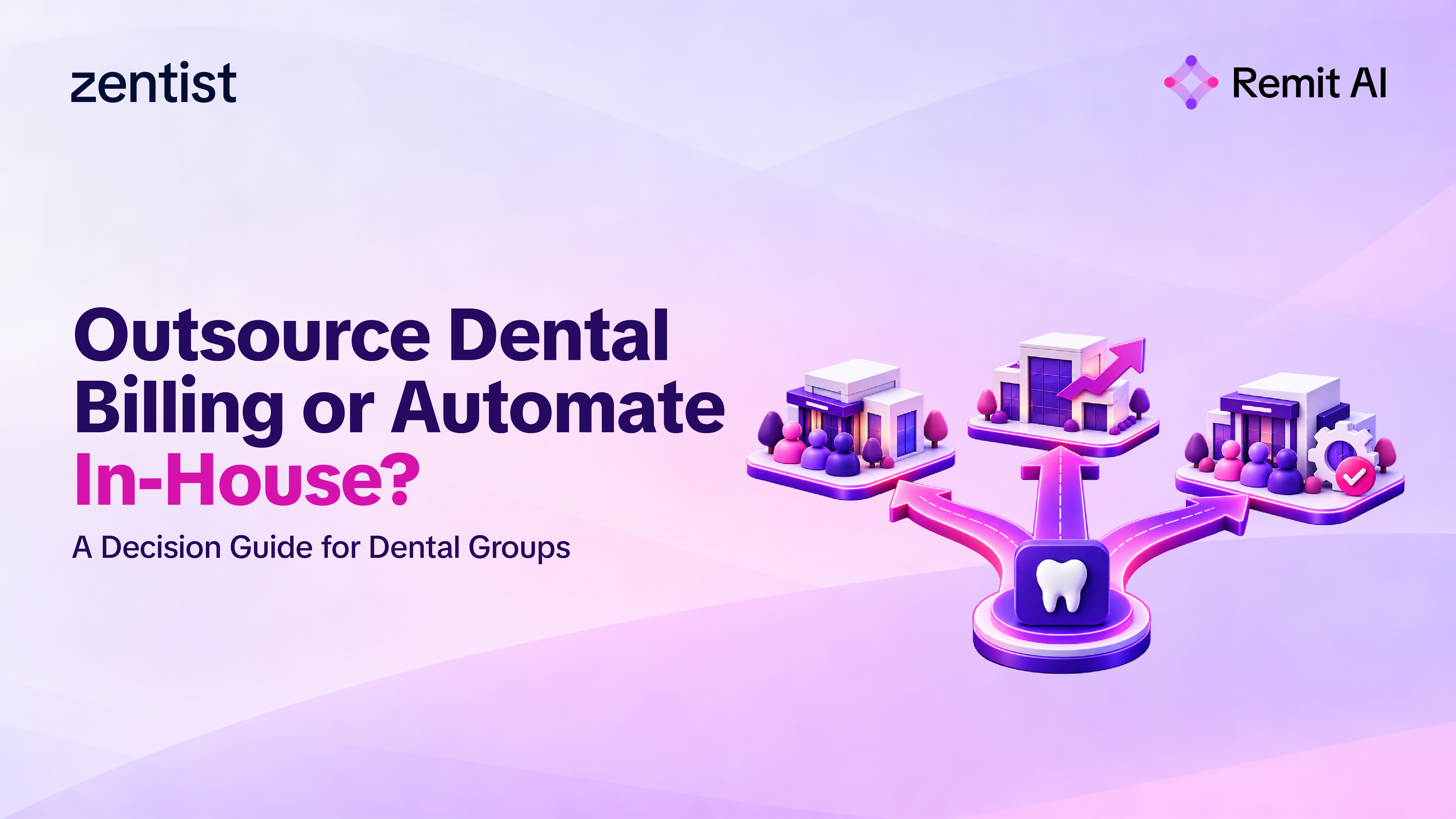
Every growing dental group reaches the same point. The billing team is stretched, AR is creeping up, and each new location adds more payer portals, more EOBs, and more exceptions. Leadership usually frames the choice as hiring more billers or outsourcing dental billing. There is a third option that many groups now choose: keep the team in-house and automate the repetitive work underneath it. This guide compares all three models on cost, control, visibility, and scale.
Should a dental group outsource billing?
Outsourcing makes sense when a group lacks an experienced billing lead, is in a staffing crisis, or needs short-term relief during rapid change. It is not automatically better or worse than in-house billing. The right choice depends on how much control, data access, and speed leadership needs.
An outsourced billing or RCM company can absorb volume without the group hiring and training every role. For a small group with no revenue cycle leadership, that can stabilize collections quickly. The tradeoff shows up later. Claims, follow-up, and posting move outside the organization, and leadership may not see denial patterns, payer changes, or location-level bottlenecks as quickly as it would with its own team. Turnaround depends on the vendor's capacity and how fast questions move between the vendor and each office.
There is also a compliance layer. Any outsourced billing partner that handles patient data is a business associate under HIPAA, which means a business associate agreement and ongoing oversight of how that partner protects PHI.

How much does dental billing outsourcing cost?
Most dental billing companies charge a percentage of collections or another volume-based fee rather than a flat rate. That converts payroll into a variable cost, which can suit a smaller group. For a growing DSO, the fee rises with revenue even when the underlying work doesn't get harder.
The less visible costs matter as much as the fee. Leadership may get a monthly summary instead of live data on why claims are denied and which locations create errors. Patient balance questions at the front desk can wait on an outside team. If the group later brings billing back in-house, workflows and documentation may need to be rebuilt from scratch. Remote dental billing teams, whether outsourced or contracted, carry the same trade-offs: the work moves away from the people who see the patients and the data. For a side-by-side look at vendors, Zentist's guide to the best dental billing companies in 2026 covers what each model includes.
What does keeping billing fully in-house cost?
A fully in-house manual billing team gives leadership the most direct control, but its cost rises with every location added. Salaries, benefits, training, overtime, and turnover all scale with claim volume, because each new office brings more portal logins, more EOBs to key, and more deposits to reconcile.
Control and data access are the strengths. Leadership sets the standards, owns the reports, and can investigate a denial trend or payment variance the same day. The weakness is dependency on people. When an experienced biller leaves, the knowledge of which portal holds which payer's EOBs often leaves with them. Zentist's 2026 Dental RCM Trends Insights Report found that 63% of practices report strong revenue but exhausted teams, and 78% of billing professionals say denials are rising. Adding headcount treats the symptom, not the cause.

What is the alternative to outsourcing dental billing?
The alternative is an in-house team supported by automation. The group keeps its billing staff and its data, while software handles the high-volume, rules-based work: collecting EOBs and ERAs, posting payments, reconciling deposits, and prioritizing AR. The team spends its time on exceptions, denials, and payer disputes instead of downloads and data entry.
This model changes the cost curve. Headcount no longer has to rise in a straight line with locations, because the repetitive work scales through software rather than people. Control stays inside the organization, and data access improves, because payments, adjustments, and denial reasons are captured in a consistent, structured way across every office. The CAQH Index estimates that the US healthcare industry still has about $21 billion a year in savings available from moving remaining manual administrative transactions to electronic ones, and dental is one of the least automated parts of that picture.
Zentist's results show what this looks like at group scale. Imagen Dental Partners grew from 5 to 20 practices per payment poster after automating posting, and Harbor Dental Clinic saved 30 hours a week of billing work. Zentist's guide on how dental groups can scale without hiring more billing staff walks through that model in detail.
How should COOs and CFOs choose a billing model?
Choose the model that matches the group's size, growth plan and need for visibility, and expect the answer to change as the group grows. A small group without billing leadership may reasonably outsource while it stabilizes. A larger DSO with clear processes usually wants in-house control. A group adding locations quickly, with rising payer complexity and pressure for timely data, gets the most leverage from automating its in-house team.
Before committing, leadership should answer a few questions honestly. How many locations and payers will the group manage after the next round of acquisitions? What are current days in AR, denial rate and payment posting lag, and are problems concentrated in certain offices? Does leadership need location-level data weekly, or is a monthly summary enough? Would outsourcing solve an immediate staffing gap but create long-term dependency? The answers usually make the decision clear.

What should dental groups automate first?
Start with the work that is high-volume, rules-based, and delayed every day: EOB and ERA collection, payment posting, reconciliation, and AR prioritization. These steps decide how fast cash shows up in the PMS and how much time the team has left for judgment work.
Remit AI collects EOBs and ERAs from 725+ payers with no portal logins, reconciles each payment against the bank deposit, and explains denials in plain English with a next step. Its Autoposting tool posts payments into all major PMS platforms. Caviar prioritizes the AR that needs attention first, and its agentic claims review logs into payer portals, diagnoses rejected claims, resubmits them, and flags anything that needs a person. For groups still receiving paper checks, Vault deposits and posts mailed payments the same day.
Automation doesn't replace the billing team. It keeps the knowledge, the data, and the decisions inside the group, while removing the manual work that made outsourcing look necessary.
Keep billing in-house without adding headcount
Zentist helps 5,000+ dental practices and DSOs scale billing with the team they already have. See how Remit AI works.
FAQ
Heading

Answer

